
LoginSign Up
Sign Up

New to SuperMe?

Sign up free to work on your questions with people who've been there, like Nidhi.

Sign up for freeLog in

Nidhi Wadmark

Director Product Management | Board Member | AI, Fintech, Healthcare, Civic Tech & CX

131K insights
Visible to Nidhi
Nidhi won't be able to see or reply to your conversation in incognito mode

About

Product leader with 15+ years experience in B2C, B2B and developer products driving AI and GenAI transformation at Fortune 500 scale. Built products serving 400M+ customers and 25M+ merchants globally, generating billions in transaction volume. Led healthcare digital transformation impacting 12M+ patients, 3x-ing engagement, and improving health outcomes. My career spans the full product lifecycle across payments, healthcare, and civic tech, from zero-to-one innovation to scaling mature products. I've built and scaled product teams of 30+ people while shipping products that fundamentally change how global enterprises operate. I believe life is too short to build bad products or services. I'm driven to create meaningful impact at scale, because when your 'why' has a heartbeat, your product has a soul. My sweet spot: the intersection of massive scale and human impact, where technology amplifies human potential. Beyond product leadership, I founded a Women in Product chapter, mentor emerging PMs, and co-produced a TV show celebrating the South Asian diaspora. I strive to lead with purpose and create with impact. Outside work, I stay grounded through Pilates/HIIT and growing food, both practices that balance discipline with experimentation. Strengths: Product Strategy | AI/GenAI Products | Enterprise Transformation | Payment Infrastructure & FinTech | Healthcare Technology | Team Leadership | Product Culture & Excellence | GTM Strategy | B2B/B2C Product Management | Conversational AI | Customer Support & Customer Success Platforms | Coaching & Mentorship | Customer-Centricity | Public-Private Partnerships

Pleasanton, California

Work Experience

Director Product Management at

Nov 2025 - Present (1y)

Build. Launch. Scale. Growth. Cisco IQ: a unified AI-powered experience that connects the entire customer journey.

Founder at

Aug 2025 - Present (1y 3m)

Fractional Product Leader. Strategy. AI. Coaching. Advising.

Product Management Coach at

Jul 2025 - Sep 2025 (2m)

In-person product management leadership coaching for teams at global technology companies.

Director Product Management at

Jul 2024 - Jul 2025 (1y)

agentic commerce | strategy | product management excellence | GTM | "GenAI Ambassador" enabling the adoption of AI at Visa.

Timeline

Nidhi Wadmark

Unknown

@twitter.com

View on 𝕏
Nidhi Wadmark
View on 𝕏
Nidhi Wadmark
View on LinkedIn
Nidhi Wadmark

Patrick Collison

@patrickc

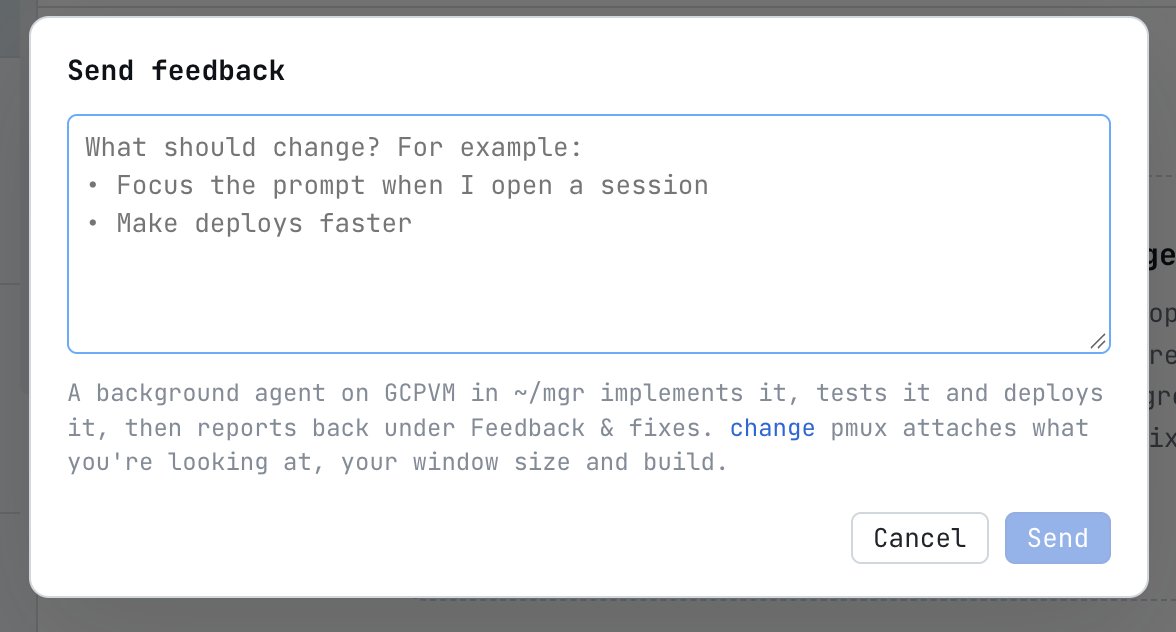
I'm now building an "improvements" feature into all of my personal vibecoded applications: a freeform text input that's hooked up to an agent that yolo implements whatever is submitted. It's an interesting experience -- the activation energy barrier to sanding any rough edge or implementing any new feature becomes extremely low. Someone else who uses one of the applications I created has already implemented 150 improvements over the course of a few days. This pattern feels like a new kind of tool -- liquid software? -- and every application that doesn't have this feature now has a slightly rigid and anachronistic flavor. Why can't I just tell it how I want it to be different? Now, it's not obvious to me how this pattern can or should scale. Does it become unmaintainable after a while? (Maybe model intelligence improvement outstrips my feature appetite such that it's fine?) How does collaborative software work in this model? Can software designed this way be secure and reliable? Whatever the larger questions about broader deployment, it definitely works great in a personal context. It reminds me a little of the visions of Lisp/Lisp machines, Smalltalk, and HyperCard -- systems that the user can take control of and modify. Those visions never quite worked, though: the vast majority of software today is not end-user modifiable in any useful way. So, while this "liquid" affordance is a very small touch, the way it changes one's relation to the software feels a bit transgressive and empowering in a Lickliderian and Engelbartian way.

I'm now building an "improvements" feature into all of my personal vibecoded applications: a freeform text input that's hooked up to an agent that yolo implements whatever is submitted.

It's an interesting experience -- the activation energy barrier to sanding any rough edge or implementing any new feature becomes extremely low. Someone else who uses one of the applications I created has already implemented 150 improvements over the course of a few days. This pattern feels like a new kind of tool -- liquid software? -- and every application that doesn't have this feature now has a slightly rigid and anachronistic flavor. Why can't I just tell it how I want it to be different?

Now, it's not obvious to me how this pattern can or should scale. Does it become unmaintainable after a while? (Maybe model intelligence improvement outstrips my feature appetite such that it's fine?) How does collaborative software work in this model? Can software designed this way be secure and reliable?

Whatever the larger questions about broader deployment, it definitely works great in a personal context. It reminds me a little of the visions of Lisp/Lisp machines, Smalltalk, and HyperCard -- systems that the user can take control of and modify. Those visions never quite worked, though: the vast majority of software today is not end-user modifiable in any useful way. So, while this "liquid" affordance is a very small touch, the way it changes one's relation to the software feels a bit transgressive and empowering in a Lickliderian and Engelbartian way.
View on 𝕏
Nidhi Wadmark
View on 𝕏