
LoginSign Up
Sign Up

New to SuperMe?

Sign up free to work on your questions with people who've been there, like Julian.

Sign up for freeLog in

Julian Harris

Professional Maker: Ex-Googler, AI product, engineering, transformation & strategy

399K insights
Visible to Julian
Julian won't be able to see or reply to your conversation in incognito mode

About

Julian Harris is Ex-Googler entrepreneur, consulting product/tech leadership (GenAI specialist). Julian has run startups before including Knowcast β€” a podcast player with an interactive voice assistant so you can learn from audio.

Kingston Upon Thames, England

Work Experience

Lead Product Manager at

Jul 2025 - Present (1y 4m)

Tremendously excited to be part of the Thunk team, leading a major project with UK regulator Ofgem helping inform UK infrastructure orgs on the impact of the climate crisis on critical national infrastructure. My role is to bringing together a cross-disciplinary team (product managers, project managers, UX research & design, frontend and backend engineering, data acquisition and modelling) spanning 5 companies in four cities to deliver a cross sector climate resilience planning tool. We are partnering with all major UK infrastructure companies including UK Power Networks, National Grid, Cadent Gas, Thames Water, Anglian Water, and many others. CReDO is a highly innovative and ambitious product with a multi-year roadmap roadmap. Part of its vision includes being able to avoid situations like Heathrow’s power outage in future by being the first solutions that actually does cross-sector failure modelling.

G
Director at Great Creations London Ltd

Nov 2015 - Present (11y)

Great Creations Ltd is my company delivering consulting and software that people love. Between March 2021 and Jan 2023 this transitioned to become the legal UK company backing my hands-free note-taking app, Knowcast.

CTO Advisory at

Feb 2026 - Mar 2026 (1m)

Helps the team plan for a migration to a fully agentic team that I lead.

AI Strategist at

Mar 2025 - Jul 2025 (4m)

Working with Exoticca leadership to formulate an AI agent strategy as well as AI readiness for their engineering team including LLM foundations and practical use of AI coding agents. This involves running workshops, building prototypes, and providing tactical experience-based advice clinics for specific AI projects.

Timeline

Julian Harris

Heyang Zhou

@heyang_zhou

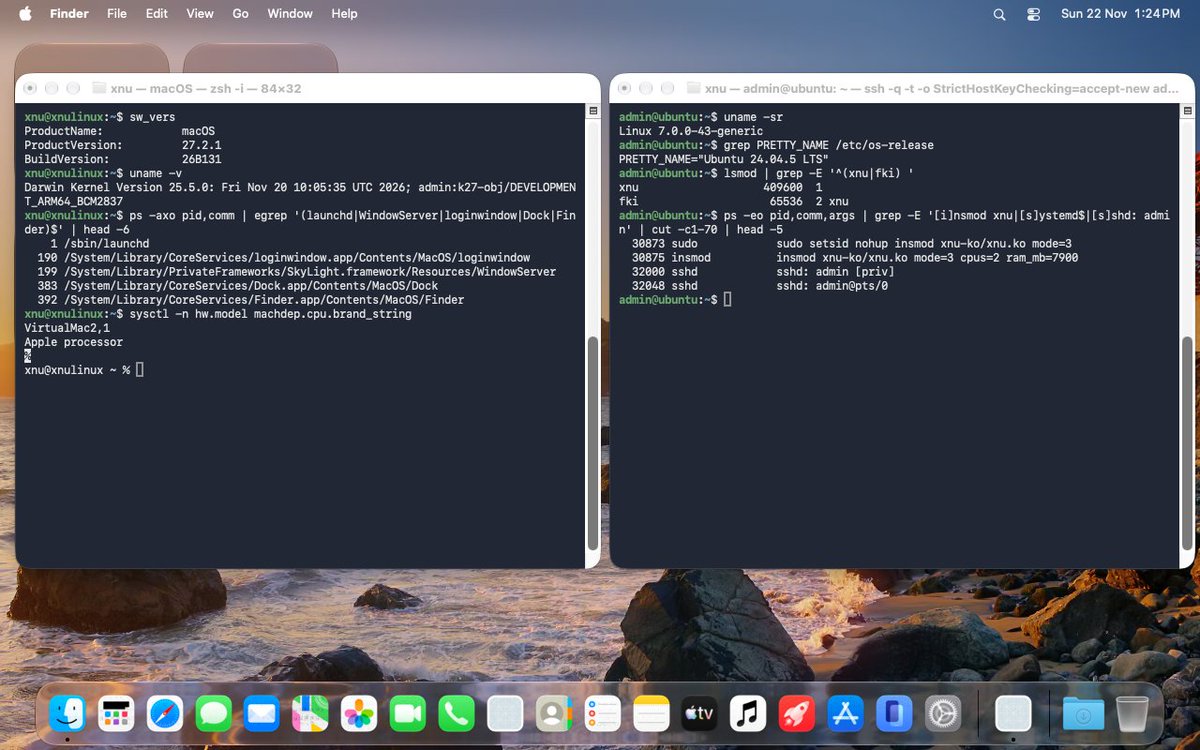
We can now run full macOS GUI userspace on Linux.

We can now run full macOS GUI userspace on Linux.
View on 𝕏
Julian Harris

Tony Parisi

@auradeluxe

One dude just killed Suno Cool

View on 𝕏
Julian Harris

Tom Greenwald

@tomgreenwald

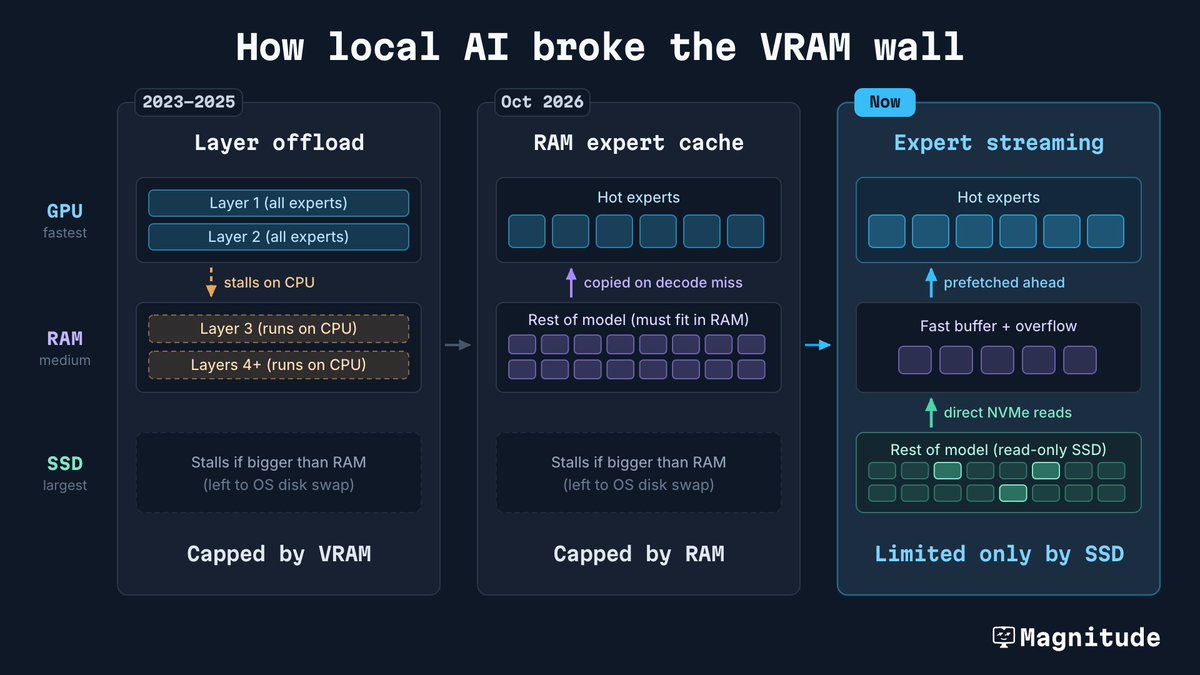
SSD is about to become the only limiting factor for local AI Most frontier open models are ultra sparse MoEs Qwen 3.8 Flash Next = 180B total, ~6B active per token (~3%) GLM 5.3 Flash = 321B total, ~18B active per token (~6%) DeepSeek V4.1 Flash = 552B total, ~16B active per token (~3%) GLM 5.3 = 753B total, ~40B active per token (~5%) Kimi K3.1 Pro = 2.8T total, ~104B active per token (~4%) When ~95% of a model sits idle on every token, keeping all of it in VRAM makes no sense Local AI has been evolving toward this for years: 2023-2025 - Layer offloading (Ollama, classic llama.cpp) This chopped whole layers across GPU and CPU, leaving the GPU waiting on CPU once VRAM filled up Oct 2026 - RAM expert cache (llama.cpp --moe-cache) This shifted from whole layers to individual experts, caching hot ones in VRAM and pulling misses from RAM. Huge leap for decode, but still capped at the size of your RAM Now - SSD expert streaming Early tools like Colibri and Strata proved direct NVMe streaming actually works on consumer hardware. Instead of hitting a VRAM or RAM wall, your SSD becomes an active part of the engine However most people hear "run from SSD" and assume 2 tok/s, which isn't entirely wrong. A few problems still exist: - Basic caching kicks out experts you're about to need again - Waiting on disk reads one layer at a time leaves the GPU and SSD sitting idle - Getting speculative decoding to work well with SSD streaming is hard - Long prompts are tough to keep fast without wiping out your hot cache - Most early tools are experimental engines built for only a couple models Making expert streaming feel fast takes solving all of those together At Magnitude, we've been working on this for the past 2 months. Here's how we solved it: - Smarter caching that keeps your session's most-reused experts in GPU memory - Speculative lookahead that pulls upcoming experts off SSD before the GPU needs them - Direct NVMe reads scheduled across layers so your SSD never sits idle - Streaming prefill that reads each cold expert once without wiping your hot cache - Built into a full engine that tunes itself to your chip across Macs and GPUs All of this together means DeepSeek V4.1 Flash on a single gaming GPU at ~40+ tok/s... We're excited to release it on Monday GitHub here: https://github.com/magnitudedev/magnitude

SSD is about to become the only limiting factor for local AI

Most frontier open models are ultra sparse MoEs

Qwen 3.8 Flash Next = 180B total, ~6B active per token (~3%)
GLM 5.3 Flash = 321B total, ~18B active per token (~6%)
DeepSeek V4.1 Flash = 552B total, ~16B active per token (~3%)
GLM 5.3 = 753B total, ~40B active per token (~5%)
Kimi K3.1 Pro = 2.8T total, ~104B active per token (~4%)

When ~95% of a model sits idle on every token, keeping all of it in VRAM makes no sense

Local AI has been evolving toward this for years:

2023-2025 - Layer offloading (Ollama, classic llama.cpp)
This chopped whole layers across GPU and CPU, leaving the GPU waiting on CPU once VRAM filled up

Oct 2026 - RAM expert cache (llama.cpp --moe-cache)
This shifted from whole layers to individual experts, caching hot ones in VRAM and pulling misses from RAM. Huge leap for decode, but still capped at the size of your RAM

Now - SSD expert streaming
Early tools like Colibri and Strata proved direct NVMe streaming actually works on consumer hardware. Instead of hitting a VRAM or RAM wall, your SSD becomes an active part of the engine

However most people hear "run from SSD" and assume 2 tok/s, which isn't entirely wrong. A few problems still exist:

- Basic caching kicks out experts you're about to need again
- Waiting on disk reads one layer at a time leaves the GPU and SSD sitting idle
- Getting speculative decoding to work well with SSD streaming is hard
- Long prompts are tough to keep fast without wiping out your hot cache
- Most early tools are experimental engines built for only a couple models

Making expert streaming feel fast takes solving all of those together

At Magnitude, we've been working on this for the past 2 months. Here's how we solved it:

- Smarter caching that keeps your session's most-reused experts in GPU memory
- Speculative lookahead that pulls upcoming experts off SSD before the GPU needs them
- Direct NVMe reads scheduled across layers so your SSD never sits idle
- Streaming prefill that reads each cold expert once without wiping your hot cache
- Built into a full engine that tunes itself to your chip across Macs and GPUs

All of this together means DeepSeek V4.1 Flash on a single gaming GPU at ~40+ tok/s...

We're excited to release it on Monday
GitHub here: https://github.com/magnitudedev/magnitude
View on 𝕏
Julian Harris

Software Mansion AI Labs

@swmansion_ai

Read more and try the model: https://runnativ.ai/blog/reverb-on-nativ -> https://huggingface.co/spaces/software-mansion/Reverb-TTS-runntime -> https://docs.swmansion.com/runntime/zoo/text-to-speech/ -> https://docs.swmansion.com/react-native-executorch/docs/next/extensions/text-to-speech#voice-cloning-reverb

Read more and try the model: 
https://runnativ.ai/blog/reverb-on-nativ

-> https://huggingface.co/spaces/software-mansion/Reverb-TTS-runntime
-> https://docs.swmansion.com/runntime/zoo/text-to-speech/
-> https://docs.swmansion.com/react-native-executorch/docs/next/extensions/text-to-speech#voice-cloning-reverb
View on 𝕏
Julian Harris
View on LinkedIn