LoginSign Up
Sign Up

New to SuperMe?

Sign up free to work on your questions with people who've been there, like Jacob.

Sign up for freeLog in

Jacob Andreou

Copilot

17K insights
Visible to Jacob
Jacob won't be able to see or reply to your conversation in incognito mode

About

Jacob Andreou is Copilot. Previously, Jacob Andreou has worked at Microsoft AI.

Los Angeles Metropolitan Area

Work Experience

EVP, Copilot at

2026 - Present (10m)

CVP, Product & Growth at

2025 - 2026 (1y)

Partner at

2023 - 2026 (3y)

SVP, Product & Growth at

2015 - 2023 (8y)

Timeline

Jacob Andreou

Salesforce

@salesforce

Introducing Copilotforce Salesforce customer context and sales workflows are coming to @MSFTCopilot and @MicrosoftTeams—where more than 400M people already collaborate Our expanded partnership with @Microsoft spans Copilot, Teams & Fabric: → Salesforce in Microsoft Copilot will help sellers prepare for meetings, spot deal risks & take supported Salesforce actions, informed by customer context, emails, meetings & shared documents → @SalesCloud in Teams will bring pipeline insights, deal alerts & supported opportunity updates into Teams, with Agentforce Coworker helping sellers delegate work & take action → Data 360 + Microsoft Fabric connect through bidirectional zero copy, so teams can access data across both platforms without duplicating source datasets → @Informatica expands its Microsoft integrations to help teams find trusted data in Copilot, build governed AI agents in Foundry & trace data lineage in Fabric @Accenture joins as Customer Zero and design and implementation partner to help shape and validate Copilotforce within its global sales organization, after scaling Microsoft Copilot to 740,000+ people See what’s new from #MSIgnite: https://sforce.co/4kgw4iZ

View on 𝕏
Jacob Andreou

Unknown

@twitter.com

Microsoft

@Microsoft

We are deeply sorry for the disruption this incident has caused our customers and partners. We know the trust they place in our services and take that responsibility extremely seriously. We are seeing broad recovery and stability across our services. This was a technical issue not related to cyber or AI / agents. The incident was introduced by an issue during an earlier network capacity upgrade that surfaced following a recent network change. We have addressed the underlying issue and continue to restore service to remaining customers and regions. Given the scale of demand, we restored services gradually, validating stability at each stage. While this took longer, it helped ensure a stable restoration. We will provide a full post-incident report once our review is complete.

View on 𝕏
Jacob Andreou

will depue

@willdepue

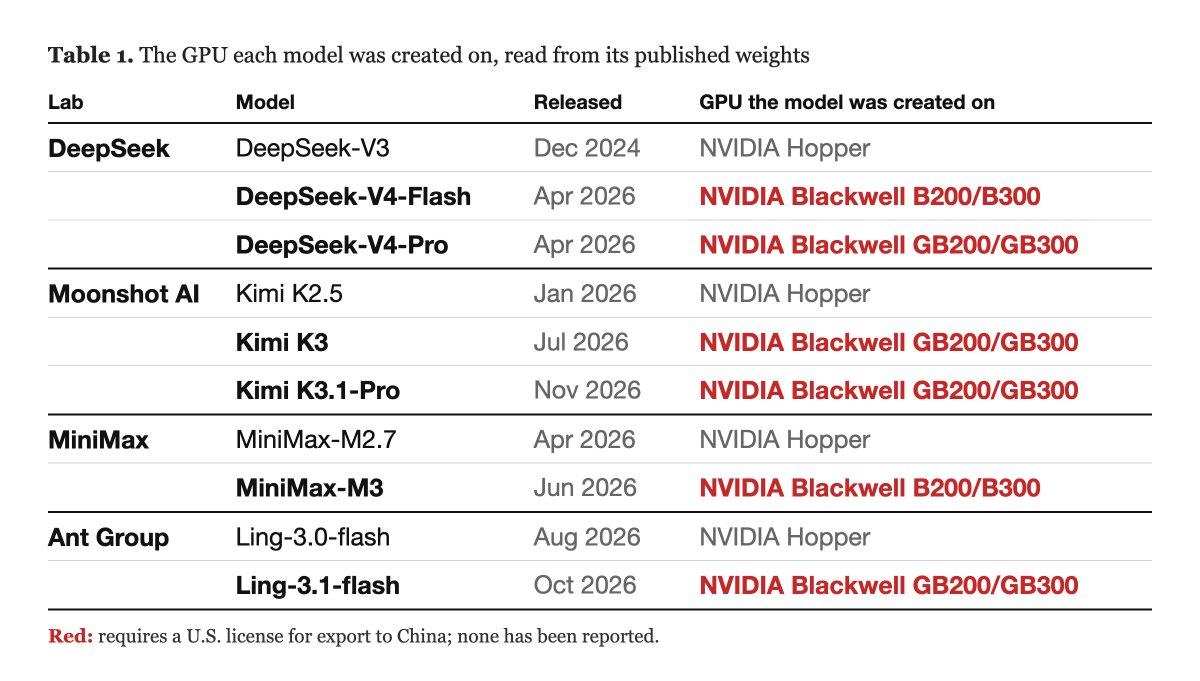
I have a major result to share. I’ve found conclusive forensic evidence that the top 4 Chinese AI labs—DeepSeek, Moonshot, MiniMax and Ant Group—have built their newest models on NVIDIA’s most advanced Blackwell chips, which are barred from export to China. This sounds insane, but I discovered that almost every AI model carries a hidden signature of the GPU that trained it. When a model is first set up, the starting values of its weights are laid out in a pattern that depends on the exact GPU. Each combination of GPU and seed number produces a unique pattern—a sort of fingerprint of the hardware used to create the model. Traces of that pattern survive training into the published model. Again, this evidence isn’t based on any insider information or leaking. It’s based on a forensic analysis of the model weights released by the companies themselves. I searched more than six trillion combinations of chip layout and seed number and matched them to open-weights models. In doing so, I found conclusive evidence that six Chinese AI models—including DeepSeek-V4-Pro, Kimi K3, and MiniMax-M3—were initialized on NVIDIA Blackwell systems. Four of the models match Grace Blackwell, the GB200 and GB300 parts in NVIDIA’s flagship liquid-cooled rack-scale systems. I then verified these results on real hardware. Running unmodified PyTorch with the seeds I’d recovered, a Blackwell B300 reproduced DeepSeek-V4-Flash’s untouched starting weights bit for bit, and a rented GB200 reproduced Kimi K3’s to a correlation of 0.999995. A Hopper H100 reproduced none of DeepSeek-V4-Flash’s, and changing the seed by one broke the match. (DeepSeek’s seed is 953049583 by the way.) The method also was verified to match 24 known open-weights models to the hardware that developers said they used. It is exceedingly unlikely that these results are a coincidence. Across six trillion combinations, the best accidental match should reach only about 8 sigma (i.e., eight standard deviations above what random chance would produce). The real matches range from 49 to 1,385 sigma, and even the weakest single test hits 20. These were data-center-scale training runs. With some analysis of release schedules and model details, I estimate that the largest, Kimi K3 and DeepSeek-V4-Pro, used 2,000 to 3,000 Blackwell GPUs each. Clusters of this size cost on the order of $150 to $200 million each to buy, and across these labs alone would add up to more than half a billion dollars of export-controlled GPUs, not counting experimental compute or otherwise. It’s quite likely that we see multi-billion dollar expenditure on export-controlled GPUs. I am highly confident in this result, and it has been independently verified by senior researchers at OpenAI and Anthropic. You can read the full report at http://unemploymentlabs.com/checkpoint-forensics. There is much more I’ve identified about these models through other forms of checkpoint forensics like this, and will have more to share soon.


I have a major result to share.

I’ve found conclusive forensic evidence that the top 4 Chinese AI labs—DeepSeek, Moonshot, MiniMax and Ant Group—have built their newest models on NVIDIA’s most advanced Blackwell chips, which are barred from export to China.

This sounds insane, but I discovered that almost every AI model carries a hidden signature of the GPU that trained it. When a model is first set up, the starting values of its weights are laid out in a pattern that depends on the exact GPU. Each combination of GPU and seed number produces a unique pattern—a sort of fingerprint of the hardware used to create the model. Traces of that pattern survive training into the published model.

Again, this evidence isn’t based on any insider information or leaking. It’s based on a forensic analysis of the model weights released by the companies themselves.

I searched more than six trillion combinations of chip layout and seed number and matched them to open-weights models. In doing so, I found conclusive evidence that six Chinese AI models—including DeepSeek-V4-Pro, Kimi K3, and MiniMax-M3—were initialized on NVIDIA Blackwell systems. Four of the models match Grace Blackwell, the GB200 and GB300 parts in NVIDIA’s flagship liquid-cooled rack-scale systems.

I then verified these results on real hardware. Running unmodified PyTorch with the seeds I’d recovered, a Blackwell B300 reproduced DeepSeek-V4-Flash’s untouched starting weights bit for bit, and a rented GB200 reproduced Kimi K3’s to a correlation of 0.999995. A Hopper H100 reproduced none of DeepSeek-V4-Flash’s, and changing the seed by one broke the match. (DeepSeek’s seed is 953049583 by the way.) The method also was verified to match 24 known open-weights models to the hardware that developers said they used.

It is exceedingly unlikely that these results are a coincidence. Across six trillion combinations, the best accidental match should reach only about 8 sigma (i.e., eight standard deviations above what random chance would produce). The real matches range from 49 to 1,385 sigma, and even the weakest single test hits 20.

These were data-center-scale training runs. With some analysis of release schedules and model details, I estimate that the largest, Kimi K3 and DeepSeek-V4-Pro, used 2,000 to 3,000 Blackwell GPUs each. Clusters of this size cost on the order of $150 to $200 million each to buy, and across these labs alone would add up to more than half a billion dollars of export-controlled GPUs, not counting experimental compute or otherwise. It’s quite likely that we see multi-billion dollar expenditure on export-controlled GPUs.

I am highly confident in this result, and it has been independently verified by senior researchers at OpenAI and Anthropic. You can read the full report at http://unemploymentlabs.com/checkpoint-forensics.

There is much more I’ve identified about these models through other forms of checkpoint forensics like this, and will have more to share soon.

View on 𝕏
Jacob Andreou

Sumit Chauhan

@sumit_c

Starting today, the full power of Microsoft Office is rolling out to the Copilot App in Frontier. We're bringing together the capabilities that your business runs on every day within Word, Excel and PowerPoint inside of the new OS for work. This new experience supports your entire workflow, from the first prompt to the finishing touches. You can collaborate with others, use branded templates, and return to earlier iterations through version history as your work evolves. In the same workspace, you can choose from a robust library of frontier models or use the Auto router to match the right model to the task at hand. Learn more in my blog post: https://techcommunity.microsoft.com/blog/microsoft-copilot-blog/introducing-office-in-the-new-microsoft-copilot-app/4561230

View on 𝕏
Jacob Andreou
View on LinkedIn