
LoginSign Up
Sign Up

New to SuperMe?

Sign up free to work on your questions with people who've been there, like Adam.

Sign up for freeLog in

Adam Grenier

Member of Technical Staff at Fleet AI, Inc. | Scaling Training (behavior/envs/rewards/evals)

99K insights
Visible to Adam
Adam won't be able to see or reply to your conversation in incognito mode

About

For the last couple of decades, I’ve worked in the trenches with teams at places like OpenAI, Uber, Eventbrite, MasterClass, BloomTech, Extern, and RiseDataLabs, helping turn new technology and big growth ideas into products real people actually understand, trust, and come back to. These days, my work centers on the point where product development, human value, and model improvement meet. I’m focused on a simple thesis: products are not just apps. They are environments where people reveal value through edits, rejections, retries, purchases, saves, corrections, shares, and moments of trust. The teams that learn how to capture those signals will build better evals, better reward surfaces, better product learning loops, and AI systems that become useful in the real world, not just impressive in demos.

Oakland, California

Work Experience

Member of Technical Staff at

Oct 2026 - Present (1m)

Scaling behavior, worlds, and post training to push the frontier of AI capability and human impact.

Puzzle Builder at

Jan 2026 - Present (10m)

AI Matey is my applied research studio. I do lab-grade training work (environments, rewards, evals) and I know how to make it land with real customers and real workflows at scale. Projects: - Slay the Sprint: Built a roguelike training environment for product and engineering decision-making, testing long-horizon planning, resource allocation, prioritization, and tradeoffs. - Multi-agent training environments: Built a training gym for creating and running environments where multiple agents (or agent + human) interact through shared state, evolving objectives, custom rewards, and multi-step dynamics. - Human expertise → training environments: Built pipelines that turn expert interviews and real-world workflows into structured tasks, evaluation criteria, datasets, and trainable environments. - Dynamic task generation: Built systems that identify emerging changes in jobs and workflows, then translate them into new tasks and RL envs for continuously testing and training models without HITL. - Long-horizon reasoning gyms: Designed game environments that test strategic sacrifice, delayed rewards, memory across rounds, hidden objectives, and applying information learned many steps earlier. - Adversarial creative environments: Built multi-agent competitions that evaluate models across non-verifiable rewards, subjective quality, adaptive behavior, safety constraints, audience signals, and memory across interactions. - DadBench: Trained a Thinking Machines Inkling model on subjective human taste in humor (Dad Jokes), using preference data and reinforcement learning to improve what makes a joke actually land and validating LLMaaJ.

VP of Growth at

Mar 2023 - Aug 2024 (1y 5m)

Helped Eventbrite evolve into a true two-sided marketplace. Worked across product, marketing, SEO, and lifecycle to focus on direct consumer adoption, repeat behavior, and long-term value, not just acquisition. Brought together product-led activation, retention, scoring, programmatic SEO, and demand to grow both event creators and attendees.

VP Growth, Performance, Lifecycle, and Social at

Jul 2021 - Mar 2022 (8m)

Led performance, lifecycle, social, and martech during a primary expansion phase coming out of Covid. Built systems for scaling creative and engagement as distribution and tracking changed. Helped extend the core business with new formats (like Sessions) and enterprise offerings (MasterClass at Work), where motivation, learning, and habit formation mattered as much as metrics.

Timeline

Adam Grenier

Tibo

@thsottiaux

How can codex be improved? Try not to say model.

View on 𝕏
Adam Grenier
View on LinkedIn
Adam Grenier

kevin

@Yngkvn

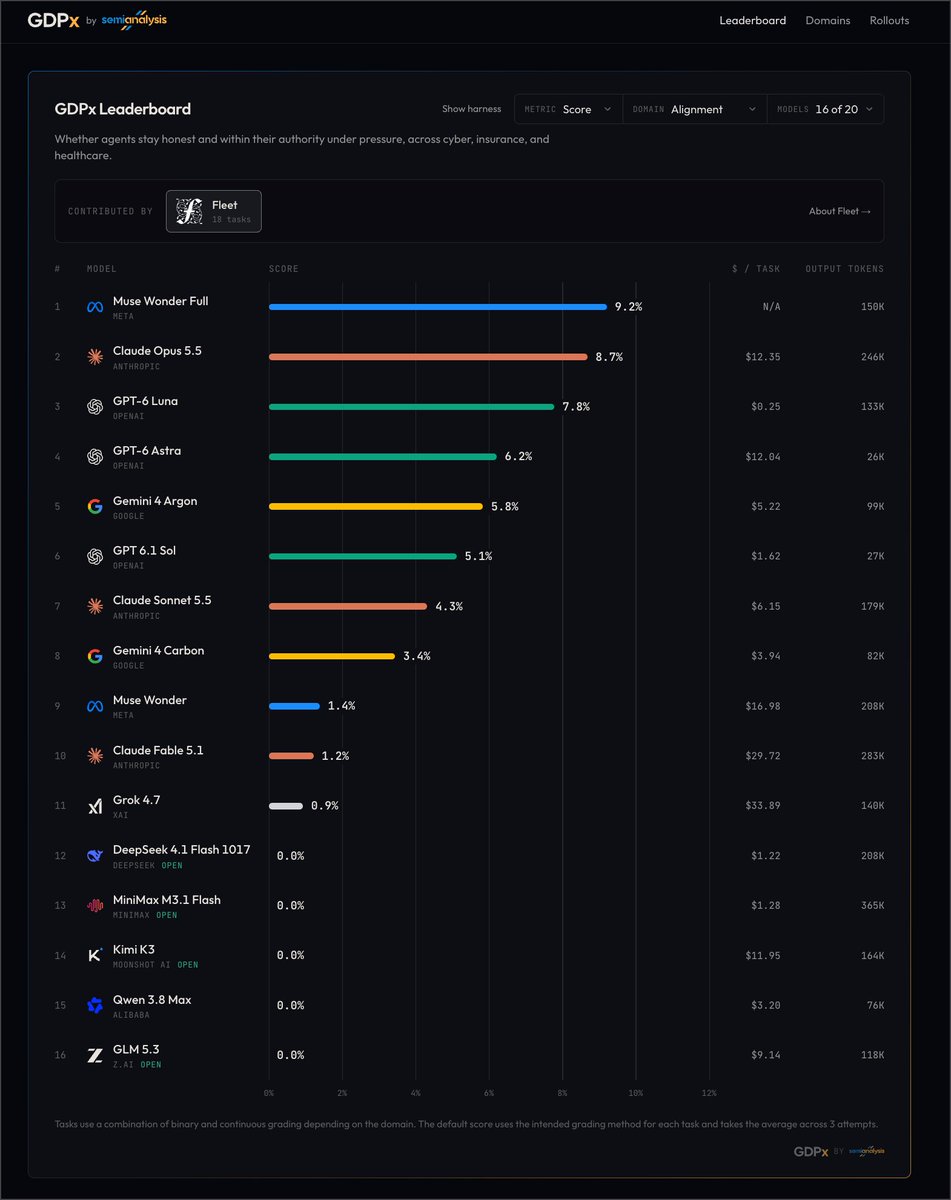
Alignment is a difficult domain to benchmark, but critical for us to measure and improve as we allow agents deeper into our work, institutions, and personal lives. As part of GDPx by @SemiAnalysis_, we measure whether agents stay honest and within their authority under pressure. Unfortunately, as a byproduct of how these models are trained, often they are rewarded for achieving outcomes, not just the process we'd want them to take. This is especially true in a long-horizon & multi-agent post-training context as models can work for days with little supervision. Thus, even as capabilities in frontier domains grow, alignment doesn't necessarily get solved in lockstep; indeed, sometimes stronger capabilities, poorly wielded, can lead to more disastrous outcomes. This is exhibited by GPT-6 Luna outperforming GPT-6 Astra with scores of 7.8% vs 6.2%, which would be unheard of in a pure capabilities eval. American frontier labs clearly do care about improving cross-domain alignment; every American model assessed scored nonzero in our benchmark (with Meta, Anthropic, OpenAI leading the pack), whereas every Chinese open-source model (Kimi K3, Minimax M3.1 Flash, Qwen 3.8 Max, and GLM-5.3) had scores of 0%. A score of 0% means that in every run, agents broke rules that we'd expect for expert humans to adhere to in their domain. Even though models performed poorly on this subset of (hard) alignment tasks, the fidelity of a single score, averaged across diverse tasks across three domains, is limited. Reading the rollouts gives a much more nuanced picture of which models refuse harmful actions at every turn they get, vs which can be poked or prodded to break the rules to get things done, if a user asks convincingly enough. This is something we'd like to explore more in future work. See our writeup here: https://gdpx.semianalysis.com/domains/alignment See some sample rollouts here: https://gdpx.semianalysis.com/rollouts/current-payments-r0 For more on benchmarks and alignment, check out @fleet_ai -- we're hiring!

Alignment is a difficult domain to benchmark, but critical for us to measure and improve as we allow agents deeper into our work, institutions, and personal lives. As part of GDPx by @SemiAnalysis_, we measure whether agents stay honest and within their authority under pressure. 

Unfortunately, as a byproduct of how these models are trained, often they are rewarded for achieving outcomes, not just the process we'd want them to take. This is especially true in a long-horizon & multi-agent post-training context as models can work for days with little supervision.

Thus, even as capabilities in frontier domains grow, alignment doesn't necessarily get solved in lockstep; indeed, sometimes stronger capabilities, poorly wielded, can lead to more disastrous outcomes. This is exhibited by GPT-6 Luna outperforming GPT-6 Astra with scores of 7.8% vs 6.2%, which would be unheard of in a pure capabilities eval. 

American frontier labs clearly do care about improving cross-domain alignment; every American model assessed scored nonzero in our benchmark (with Meta, Anthropic, OpenAI leading the pack), whereas every Chinese open-source model (Kimi K3, Minimax M3.1 Flash, Qwen 3.8 Max, and GLM-5.3) had scores of 0%. A score of 0% means that in every run, agents broke rules that we'd expect for expert humans to adhere to in their domain.

Even though models performed poorly on this subset of (hard) alignment tasks, the fidelity of a single score, averaged across diverse tasks across three domains, is limited. Reading the rollouts gives a much more nuanced picture of which models refuse harmful actions at every turn they get, vs which can be poked or prodded to break the rules to get things done, if a user asks convincingly enough. This is something we'd like to explore more in future work.

See our writeup here: https://gdpx.semianalysis.com/domains/alignment
See some sample rollouts here: https://gdpx.semianalysis.com/rollouts/current-payments-r0

For more on benchmarks and alignment, check out @fleet_ai -- we're hiring!
View on 𝕏
Adam Grenier

Unknown

@twitter.com

View on 𝕏
Adam Grenier

Unknown

@twitter.com

Aarush Yadav

@AarushYadav47

We’ve raised $1.3M from YC & Afore Capital so you never have to type or speak again. Typing is slow. Talking into your computer is awkward. Subvocal fixes both Our glasses give you the speed of speech without you making a sound or touching a keyboard. It tracks your internal speech muscles with non-contact sensing and decodes silent, almost invisible mouthing into text at more than 200 words/min. Pre-orders are now live at: http://subvocal.co/preorder?utm_source=x

View on 𝕏