LoginSign Up

Valerio Sudrio

Founder & Product Leader | B2B SaaS ($15M to $100M+ ARR) | Ex-Google
51K insights
Visible to Valerio
Valerio won't be able to see or reply to your conversation in incognito mode
Ask about me
Learn from my insights
Jam on a problem
I build digital products adopted by thousands of business, and the partner ecosystems that scale them to category leadership.I'm a product leader and now two-time founder operating at the intersection of product, technol...
London Area, United Kingdom
Valerio Sudrio

Rakesh Gohel 🇨🇦

@rakeshgohel01

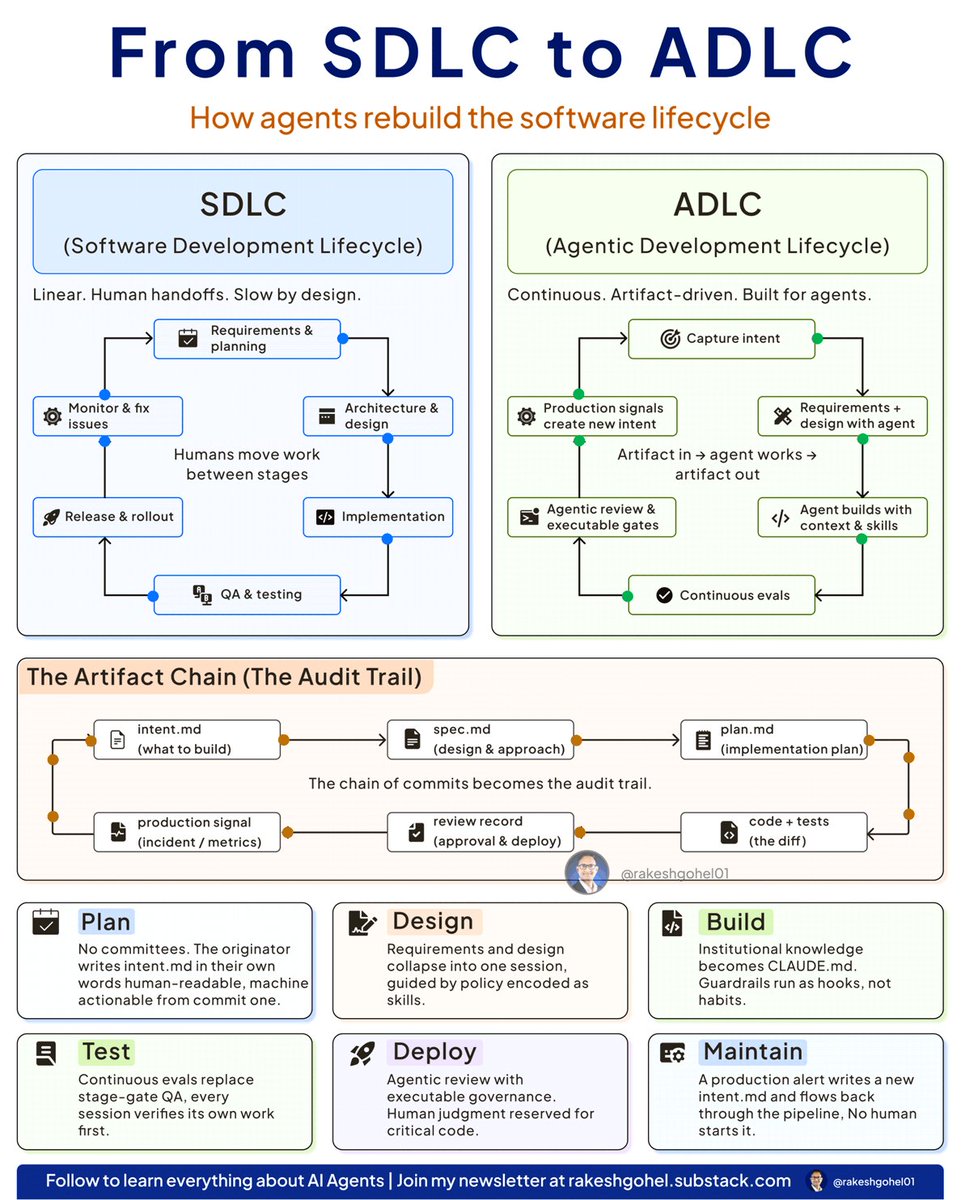
The SDLC is dead. Long live the ADLC. For years, software ran on the SDLC - the Software Development Lifecycle. Plan, Design, Build, Test, Deploy, Maintain. Six stages, each owned by a different team, work moving between them through tickets, documents, and sign-offs. Every gate in that process existed for one reason: writing code was slow and expensive. So we built rituals to force alignment during the weeks or months of build work. That premise is gone. When agents write most of the diff, the build phase collapses to hours and the whole lifecycle has to be rebuilt around a new centre of gravity. Not code. Agents. Welcome to the ADLC: the Agentic Development Lifecycle. Anthropic calls it the "AI-native SDLC" (or agentic SDLC) - same shift, whatever you name it. 📌 Here's what changes at each stage 👇 ➝ Plan: No more committees distilling requirements through workshops. The originator captures intent.md in their own words human-readable, version-controlled, machine-actionable from the first commit. ➝ Design: Requirements and design collapse into one session with an agent, guided by policy encoded as skills not discovered in a review three weeks later. ➝ Build: Institutional knowledge that used to live in people's heads becomes CLAUDE.md files the agent reads every session. Guardrails run as hooks, not as habits. ➝ Test: Continuous evals replace stage-gate QA. Every session verifies its own work tests, builds, screenshots before a human ever sees it. ➝ Deploy: Layers of agentic review. Human judgment gets reserved for critical code. Governance is enforced as the agent acts, with hooks as approval gates. ➝ Maintain: The loop closes. A production alert writes a new intent.md and flows back through the pipeline with no human in the invocation path. The difference between SDLC and ADLC isn't speed. It's structure. SDLC was a linear handoff between humans. ADLC is a loop where every stage commits an artifact the next stage reads and the chain of commits becomes the audit trail. Humans don't leave the loop. They move above it from writing every line to reviewing what the agent flagged. 📌 More AI agent insights → https://rakeshgohel.substack.com/subscribe 📘 Grab your copy → The Human-Agent Orchestrator: https://amzn.to/4gEIzmv Save 💾 React 👍 Share ♻️ - follow for daily AI agent breakdowns #AIAgents #AgenticAI #GenerativeAI #EnterpriseAI #SDLC #ClaudeCode #softwerenginnering

The SDLC is dead. Long live the ADLC.

For years, software ran on the SDLC - the Software Development Lifecycle. Plan, Design, Build, Test, Deploy, Maintain. Six stages, each owned by a different team, work moving between them through tickets, documents, and sign-offs.

Every gate in that process existed for one reason: writing code was slow and expensive. So we built rituals to force alignment during the weeks or months of build work.

That premise is gone.

When agents write most of the diff, the build phase collapses to hours  and the whole lifecycle has to be rebuilt around a new centre of gravity. Not code. Agents.

Welcome to the ADLC: the Agentic Development Lifecycle. Anthropic calls it the "AI-native SDLC" (or agentic SDLC) - same shift, whatever you name it.

📌 Here's what changes at each stage 👇

➝ Plan: No more committees distilling requirements through workshops. The originator captures intent.md in their own words  human-readable, version-controlled, machine-actionable from the first commit.

➝ Design: Requirements and design collapse into one session with an agent, guided by policy encoded as skills  not discovered in a review three weeks later.

➝ Build: Institutional knowledge that used to live in people's heads becomes CLAUDE.md files the agent reads every session. Guardrails run as hooks, not as habits.

➝ Test: Continuous evals replace stage-gate QA. Every session verifies its own work  tests, builds, screenshots  before a human ever sees it.

➝ Deploy: Layers of agentic review. Human judgment gets reserved for critical code. Governance is enforced as the agent acts, with hooks as approval gates.

➝ Maintain: The loop closes. A production alert writes a new intent.md and flows back through the pipeline with no human in the invocation path.

The difference between SDLC and ADLC isn't speed. It's structure.

SDLC was a linear handoff between humans. ADLC is a loop where every stage commits an artifact the next stage reads and the chain of commits becomes the audit trail.

Humans don't leave the loop. They move above it from writing every line to reviewing what the agent flagged.

📌 More AI agent insights → https://rakeshgohel.substack.com/subscribe

📘 Grab your copy → The Human-Agent Orchestrator: https://amzn.to/4gEIzmv

Save 💾 React 👍 Share ♻️ - follow for daily AI agent breakdowns

#AIAgents #AgenticAI #GenerativeAI #EnterpriseAI #SDLC #ClaudeCode #softwerenginnering

View on 𝕏
Valerio Sudrio
View on LinkedIn
Valerio Sudrio
View on LinkedIn
Valerio Sudrio
View on LinkedIn
Valerio Sudrio
10mo

Shared link

👀
👍
2
Get the App
New to SuperMe?

Sign up free to work on your questions with people who've been there, like Valerio.Download SuperMe for the best experience