Biopharma leaders - are you developing (or competing against) T-cell engagers?
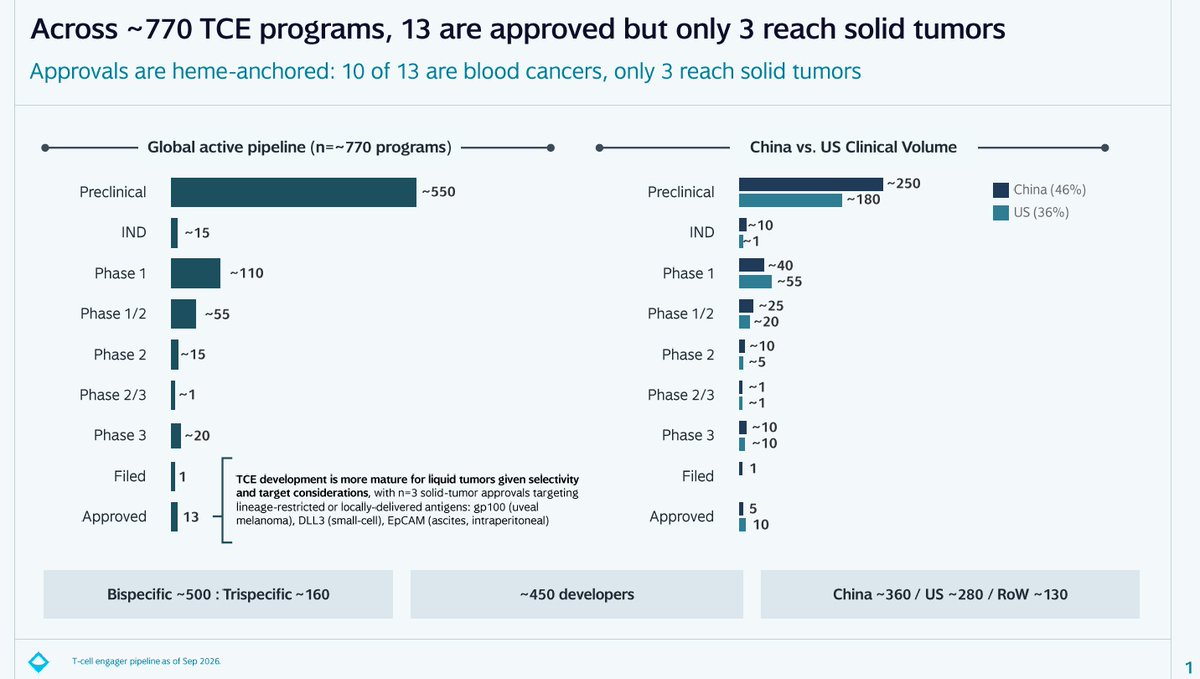
We analyzed 750+ TCE programs across 450+ developers, including hundreds of early-stage Chinese programs to determine what's trending and where the space is headed next.
While TCEs are approved in oncology, nearly all of the excitement is driven by the potential in autoimmune disease.
This makes sense - TCEs have largely succeeded when they target "clean", lineage-restricted cells, which is why they've worked well in B-cell malignancies or multiple myeloma but struggled against shared antigens in solid tumors. Autoimmune disease ports a lot of that underlying biology that made them successful, while opening up massive, chronic markets.
The rules of engagement are different here though - the winner won't just be the deepest depleter.
1st gen autoimmune TCEs were repurposed from oncology, but the disease profile is so different: oncology tolerates substantial tox in exchange for tumor killing, but autoimmune patients have a non-fatal chronic disease, and thus much less tolerance for CRS or serious infections.
This is why the engineering around the molecule is so critical (a theme we see playing out across the industry right now). About half the entire TCE pipeline already includes engineering beyond a CD3 x TAA bispecific, with distinct levers emerging for TCEs designed specifically for autoimmune disease:
• Masking or conditional activation
• Dual B-cell targeting
• 2+1 avidity formats
• CD3 affinity attenuation or immune tuning
• SubQ administration / dosing optimizations
The number of levers available to developers now to design new TCE constructs + the wide array of potential autoimmune diseases with sub-standard SOC will lead to market fragmentation.
The optimal product profile for refractory SLE won't necessarily be the same one for RA. The underlying biology, current treatment paradigm, patient burden and specific manifestations (heme, neurologic, joint, etc.) will create different requirements around depletion depth, safety, durability & dosing.
And Pharma's commercial model is closely tied to building diseases franchises managed by similar specialists. In a more fragmented market, this creates an advantage for portfolios of closely related assets each targeting specific segments of the treatment sequence.
(Hint for biotechs to sharpen BD: map where your program complements Pharma's existing franchises or fills a gap in their treatment ladder)
Of course, that's not to say these drugs won't be huge. A well-designed TCE could own the messy middle: refractory patients who need deeper depletion than conventional biologics, but for whom CAR-T level risk is disproportionate. And as safety gets proven, winning assets will go earlier.
There's a lot more in the report, covering:
• China (of course)
• Emerging strategies for solid tumors
• Review of clinical readouts
If you'd like it, just comment "TCE" below and we'll send it over!