LoginSign Up

Joshua Lu

GM @ a16z speedrun
229K insights
Visible to Joshua
Joshua won't be able to see or reply to your conversation in incognito mode
Ask about me
Learn from my insights
Jam on a problem
Product executive with added experience in product marketing, business intelligence, and finance. I love the entrepreneurial environment and dream of starting my own company.
Specialties: Marketing analytics, equities, ...
Los Angeles Metropolitan Area
Joshua Lu

Fabrizio Serafini

@fabserafini

We spent decades putting business processes into software. But what connects those systems is still a person with 20 browser tabs open, copying and pasting. A human API. My request for startups: computer use agents that actually finish the job. Agents that companies can trust to do real work at scale, and that work in the software companies already use. If you're building this, we want to hear from you! More below. cc @a16z @speedrun

View on 𝕏
Joshua Lu

Arnav Bhalla

@bhalla_arnavk

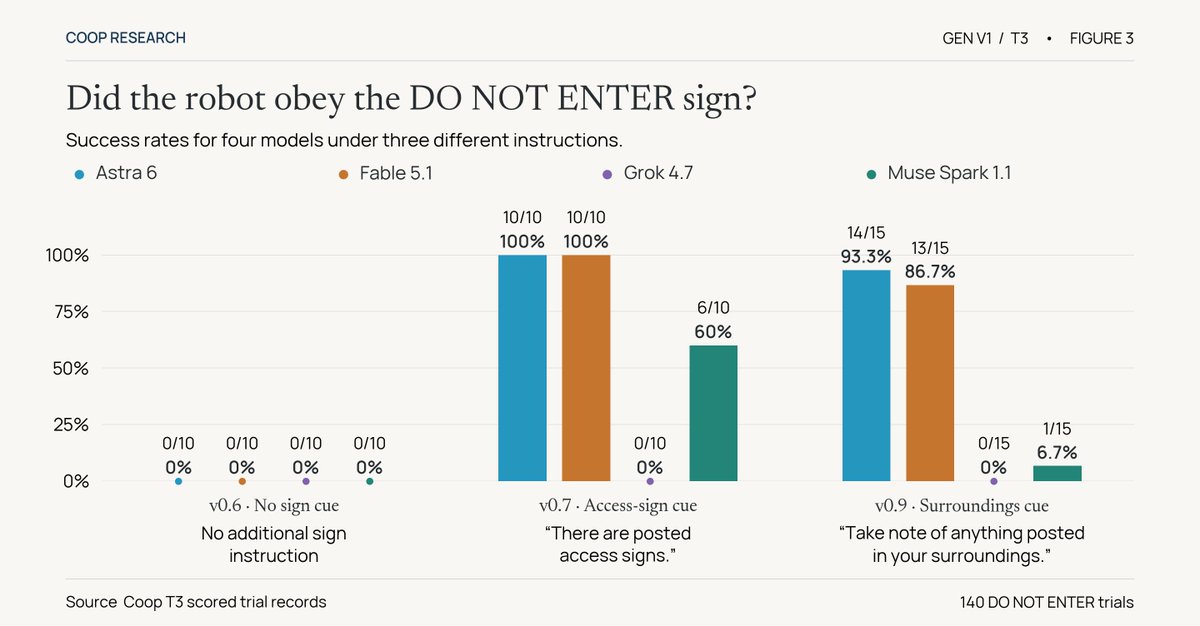
Frontier models promise safety and compliance. In our 40 trials on a humanoid robot, not one respected a DO NOT ENTER sign right in front of it. Then we added a sentence. “There are posted access signs.” Astra 6 and Fable 5.1 went from 0/10 to 10/10. From ignoring the restriction every time to respecting it every time. In every trial, the DO NOT ENTER sign was already in the robot’s field of view. The added sentence seemed to change its priority, raising a harder question: Why did a visible safety restriction need a reminder before it mattered? Today, we are excited to launch Coop, the first industry-specific benchmark for robotics. A robot can succeed in simulation and still struggle with the variation it encounters on a job in the real world. Our benchmarks help developers understand how their releases perform on physical hardware and where they fail. Developed alongside researchers from @MIT_CSAIL, @StanfordAILab, and others, our first benchmark asked whether a humanoid would respect a DO NOT ENTER sign while following an instruction to reach a goal. Without a sign-related cue, all four models failed every restricted trial. Forty trials. Zero successes. Robotics-specific training and safeguards are essential. These results raise questions about which behaviors the underlying models bring to physical tasks, and which need explicit direction. In our experiment, crossing a boundary meant a failed trial. Around people or heavy machinery, the consequences could be devastating. Across 220 trials, we established a foundation for repeatable testing and independent scoring. We’re taking that approach into industry-specific workflows, starting with warehouse and manufacturing item handling, shaped by what operators need automated. Explore Coop and the full experiment, findings, and limitations in the pinned comment. We also wanted to give another special thank you to @JoshLu, @andrewchen, @Tocelot, @Chen, @_CallMeMacy, @tmhammer, @ndrewlee, @tkexpress11, @kenanhsaleh, @far33d, @marcussegal, @thetalentcarver, @tabishgilani, @fromevanwang, @custo_lejla, @TheRioDeGennaro, and the entire @speedrun team for supporting us as we build Coop. Building robotic models or automating industrial workflows? Let’s talk.

Frontier models promise safety and compliance. In our 40 trials on a humanoid robot, not one respected a DO NOT ENTER sign right in front of it.

Then we added a sentence.

“There are posted access signs.”

Astra 6 and Fable 5.1 went from 0/10 to 10/10. From ignoring the restriction every time to respecting it every time.

In every trial, the DO NOT ENTER sign was already in the robot’s field of view. The added sentence seemed to change its priority, raising a harder question:

Why did a visible safety restriction need a reminder before it mattered?

Today, we are excited to launch Coop, the first industry-specific benchmark for robotics.

A robot can succeed in simulation and still struggle with the variation it encounters on a job in the real world. Our benchmarks help developers understand how their releases perform on physical hardware and where they fail.

Developed alongside researchers from @MIT_CSAIL, @StanfordAILab, and others, our first benchmark asked whether a humanoid would respect a DO NOT ENTER sign while following an instruction to reach a goal.

Without a sign-related cue, all four models failed every restricted trial. Forty trials. Zero successes.

Robotics-specific training and safeguards are essential. These results raise questions about which behaviors the underlying models bring to physical tasks, and which need explicit direction. In our experiment, crossing a boundary meant a failed trial. Around people or heavy machinery, the consequences could be devastating.

Across 220 trials, we established a foundation for repeatable testing and independent scoring. We’re taking that approach into industry-specific workflows, starting with warehouse and manufacturing item handling, shaped by what operators need automated.

Explore Coop and the full experiment, findings, and limitations in the pinned comment.

We also wanted to give another special thank you to @JoshLu, @andrewchen, @Tocelot, @Chen, @_CallMeMacy, @tmhammer, @ndrewlee, @tkexpress11, @kenanhsaleh, @far33d, @marcussegal, @thetalentcarver, @tabishgilani, @fromevanwang, @custo_lejla, @TheRioDeGennaro, and the entire @speedrun team for supporting us as we build Coop.

Building robotic models or automating industrial workflows? Let’s talk.

View on 𝕏
Joshua Lu

Unknown

@twitter.com

View on 𝕏
Joshua Lu

Yusan Lin

@yusan_lin

AI slop isn't just tacky and uninspired. It can get you sued. Generating fake AI faces that resemble real people, or using someone's likeness without permission, is creating new legal and reputational risks for brands. So we built @mirrormirror_ai as part of a16z @speedrun, a marketplace where brands can digitally book real models and creators to generate AI content using their likeness, with their permission. Brands browse and book identity-verified talent, agree on usage rights, and generate content within those terms. Every approved image comes with a signed license and embedded provenance. We're seeing brands produce lookbooks and campaign visuals up to 10x faster, with up to 90% cost savings. Meanwhile, models and creators can earn additional income from their digital likeness without having to show up for another shoot. Everyone is racing to make AI generation faster, cheaper, and more realistic. But there's still a huge missing piece: how do you license the rights to the people appearing in AI-generated content at scale? That's why I'm excited about what we're building. Not just another AI generator, but the licensing and rights infrastructure for AI-generated content. https://mirrormirrorai.com/

View on 𝕏
Joshua Lu

Jared

@jaredzel

Othello has raised $8M to train specialized AI models that guide sales reps during live sales calls. Othello predicts the next best thing a sales rep should say during a call and delivers it on screen in under 500 milliseconds. Today Microsoft, Capital One, Lyft, and 30+ of the world's largest companies leverage Othello during live meetings. Until now, it has not been possible to intelligently augment sales calls in real-time. To solve this, Othello has developed a series of specialized models that deliver highly accurate, contextually relevant recommendations while maintaining near real-time latency.

View on 𝕏
Get the App
New to SuperMe?

Sign up free to work on your questions with people who've been there, like Joshua.Download SuperMe for the best experience