LoginSign Up

Charlie Wiser

Technology founder and product-minded operator across crypto, consumer, and enterprise AI. Helping startups win.
105K insights
Visible to Charlie
Charlie won't be able to see or reply to your conversation in incognito mode
Ask about me
Learn from my insights
Jam on a problem
I'm building Pong — making sure your team's best work doesn't stay trapped in Claude, ChatGPT, and Slack DMs.Your team produces real, valuable work in those tools every day. Playbooks, customer responses, troubleshooting...
San Francisco, California
Charlie Wiser

Stripe Press

@stripepress

Nomad Letters: The Full Collection of the Nomad Investment Partnership Letters to Partners, 2001–2014, now available for preorder: https://press.stripe.com/nomad-letters

Nomad Letters: The Full Collection of the Nomad Investment Partnership Letters to Partners, 2001–2014, now available for preorder: https://press.stripe.com/nomad-letters
View on 𝕏
Charlie Wiser
View on 𝕏
Charlie Wiser

Ila Mathur

@ilaamathur

Today, @via_ai_ is coming out of stealth to provide enterprises frontier AI coding at half the cost. We are a team of Olympiad camp qualifiers (with multiple gold medals), researchers, and repeat founders from Stanford and IIT. Via is backed by @jeffawilke (ex-CEO Amazon Worldwide Consumer), @manikgupta (ex-Uber CPO), @shaileshrao (ex-Google MD), and other legends from Anthropic, Apple, Snowflake, and Twitter. @ShrayAlag and I left Stanford CS to build Codegraph, an LLM-optimized compression algorithm. Codegraph put Via at the top of SWE-Bench Verified for several months of 2025, ahead of Anthropic, OpenAI, Cognition, and Cursor (single model, no test-time compute). Now, we’re bringing this research, alongside our new Umami agent architecture, to market. Via integrates in 10 seconds with any CLI / IDE and runs within your enterprise’s VPC. On benchmarks, Via and Via US (US-only models) set a new standard of performance: - On DeepSWE v1.1, Claude Code (Opus 5.5) is 306% the cost of Via US. Via US is equally accurate. • Devin Fusion is 244% the cost of Via US, Cursor Router is 294%. - On Terminal Bench 4.0, Claude Code (Opus 5.5) is 150% the cost of Via. Via is more accurate. • Devin Fusion is 155% the cost of Via, Cursor Router is 134%. We are in production at a public healthcare company, with trials underway at several of the largest tech companies in Silicon Valley. We have room for 5 more enterprises before the end of the year. DM me or email pilot@via.dev and we’ll get back to you very soon. See the comments for how Via would deploy for your team.

View on 𝕏
Charlie Wiser

Charlie Wiser

@wisercharlie

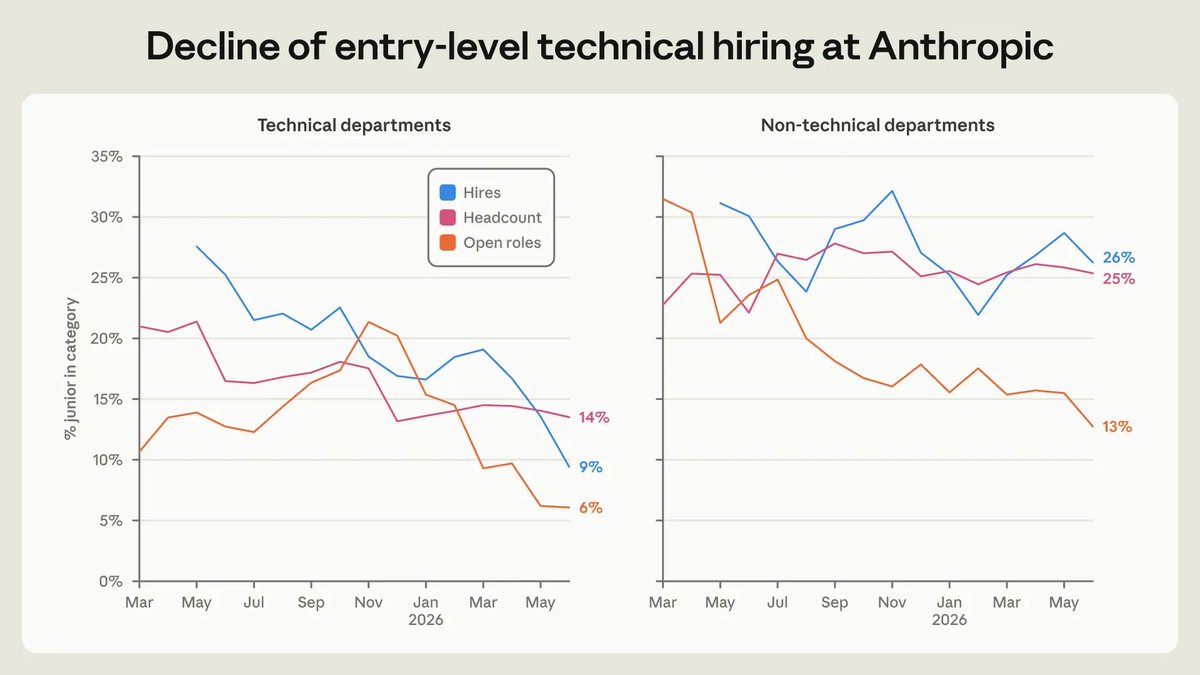
Interesting data from Anthropic on how AI is changing their own workforce (link below). Some data points that stood out to me: 1. Agent hours now outnumber human hours 6 to 1, yet Claude sessions spend around 80% of their time idle, waiting on human input. The bottleneck is human attention & judgment. 2. The junior share of Anthropic’s technical hires fell from 27% to 9% in about a year 3. Anthropic employees expect AI will be able to do 75% of their current work by 2030, the average US worker says 28%. 4. And yet Anthropic tripled in size over the last year, with technical hiring still growing in absolute terms. As old tasks get automated, employees are shifting to new ones, moving across departments 50% more often than in 2025.

Interesting data from Anthropic on how AI is changing their own workforce (link below).

Some data points that stood out to me:

1. Agent hours now outnumber human hours 6 to 1, yet Claude sessions spend around 80% of their time idle, waiting on human input. The bottleneck is human attention & judgment.

2. The junior share of Anthropic’s technical hires fell from 27% to 9% in about a year

3. Anthropic employees expect AI will be able to do 75% of their current work by 2030, the average US worker says 28%.

4. And yet Anthropic tripled in size over the last year, with technical hiring still growing in absolute terms. As old tasks get automated, employees are shifting to new ones, moving across departments 50% more often than in 2025.
View on 𝕏
Charlie Wiser

GREG ISENBERG

@gregisenberg

I spent 48 hours in SF hanging out with billionaires, data labs and AI founders and execs running $1B to $100B companies. My observations: 1. Sooo MANY stories of data brokers making like $2M a WEEK selling company data to labs. I can't tell if it's the beginning or a bubble, and I kept wondering which niches are left. Digging into it actively. 2. At dinner, someone asked the table, "If a new model drops next month, does your company get better or worse?" HALF the table went quiet! I think that's the best question to ask about any AI startup right now. 3. The bar people talk about now is hitting $1B in revenue in 12 months (I guess that's the new unicorn?). What I didn't hear much about is retention. AI revenue can come in fast and leave fast, and I think we're going to see a lot of stories of AI companies with huge revenue and terrible retention. 4. It's pretty clear we're living through the reinvention of the computer. The model is the CPU, the harness is the operating system, and skills and plugins are the apps. Thinking about it that way makes it easier to see where the whitespace is. 5. We're maybe 12 months from an agent that can watch you work for a week and then do your job without any instructions. The screen recording plus agent memory plus local model combination makes this possible right now. 6. Agent harnesses feel like the new GPT wrappers, in a good way, especially vertical ones. The best teams I talked to treat the model as swappable. One founder walked me through routing different models to different jobs: one for taste and visuals, a cheaper one for the everyday stuff, another for text. They use prompts they can move across models over fine-tuning, and A/B test the output on what users actually do with it: do they edit it, export it, share it? A vertical harness is basically four things: the connectors for that industry's data, evals written by people who know the work, rules for what the agent can and can't touch, and a clean screen for a human to review. The model is maybe 20% of it. 7. There's a lot of reverse engineering going on/cloning going on more than I've ever seen. People are decompiling software and rebuilding it with agents, and someone showed a suite of like 10 apps that are worth $5B+ each all that he cloned open source. Me and everyone are still thinking through what it means when software gets this easy to copy. 8. My guess is the value moves to data. If the software can be rebuilt quickly, what's worth paying for in a legacy SaaS company is the years of customer data and workflows inside it. Some SaaS companies are secretly data companies. Gets me thinking about how do you truly value data for this saas companies? Like if we were buying these dying saas companies at 2x ARR before (as example), maybe there is a better metric. Idk, just thinking out loud here. 9. It feels like a good chunk of legacy software won't make it to the agentic era, especially anything built around people clicking through a lot of screens. 10. Every company I talked to wants to pipe its internal data into one place and expose it to agents through MCP. Then they look at the data and realize it's a mess: five versions of the same customer, old Slack channels, PDFs nobody can search. Cleaning that up feels like a big consulting opportunity! 11. A lot of founders are building the basic building blocks for agents: APIs, data layers and tools. Some of the companies I saw barely have a UI because the main user is an agent. I really believe the startups that build primitives to this agentic era will do extremely well. Building blocks is the best way to think about it. 12. Labs can get plenty of training data, but it's harder to get real examples of agents failing inside companies. Whoever has those logs has something valuable. 13. Someone running a big consumer company told me the next fight is over memory. The model that remembers the most about you wins, and the smartest model matters less than people think. 14. Physical AI came up a lot. Astra I think was the first model that got people into AI can actually do CAD, and I think a lot of people are thinking what does vibe manufacturing really look like. The line I keep thinking about came from a robotics founder: the hardest problems in AI are deployment problems now, not research problems. Their robots work on their own, call a human when they get stuck, and every one of those calls becomes training data. 15. Cybersecurity companies are having a moment and are actually cool companies to build now, especially the ones that clean up after a breach. Every agent with access to your systems is a new door into your company, and a lot of those doors were left open. 16. Some startups are worth more dead than alive now. A shutdown company with 5 years of Slack, email and code can get paid for licensing all of it. I wouldn't be surprised if founders start factoring that into when they shut down. 17. People are starting to talk about monetizing the agent web. It feels really early, but when the most popular user of the internet is an agent, what startups should you be building? 18. I think agent insurance is coming. Once an agent makes an expensive mistake, insurers will want audits before they cover anyone. 19. Several people said the hire they want most is someone with taste who can write evals. The models are getting good at generating ideas, so the hard part is judging which ones are good. 20. New trend I observed: startup raises VC, uses venture dollars to become a creator, startup fails, founder falls back on being a full-time creator and incubates other products bootstrapped. 21. Getting SIGNIFICANT distribution is HARD right now. Founders are sponsoring buses, buying billboards like crazy and throwing parties with famous DJs to get noticed. Kinda feels dotcom era in that sense. Attention is what's scarce! The growth guy going viral sharing his UGC strategy from Wispr Flow is a good example. It's the sauce everyone wants, and I truly believe there are probably only 50 people on the planet who know how to scale these types of businesses efficiently in this era. Always good to get that dose of SF. I felt sooo lucky to have such an incredible trip during such an incredible time in building businesses. Surreal in so many ways. Happy to be home and locked in. Until next time!

I spent 48 hours in SF hanging out with billionaires, data labs and AI founders and execs running $1B to $100B companies.

My observations:

1. Sooo MANY stories of data brokers making like $2M a WEEK selling company data to labs. I can't tell if it's the beginning or a bubble, and I kept wondering which niches are left. Digging into it actively.

2. At dinner, someone asked the table, "If a new model drops next month, does your company get better or worse?" HALF the table went quiet! I think that's the best question to ask about any AI startup right now.

3. The bar people talk about now is hitting $1B in revenue in 12 months (I guess that's the new unicorn?). What I didn't hear much about is retention. AI revenue can come in fast and leave fast, and I think we're going to see a lot of stories of AI companies with huge revenue and terrible retention.

4. It's pretty clear we're living through the reinvention of the computer. The model is the CPU, the harness is the operating system, and skills and plugins are the apps. Thinking about it that way makes it easier to see where the whitespace is.

5. We're maybe 12 months from an agent that can watch you work for a week and then do your job without any instructions. The screen recording plus agent memory plus local model combination makes this possible right now.

6. Agent harnesses feel like the new GPT wrappers, in a good way, especially vertical ones. The best teams I talked to treat the model as swappable. One founder walked me through routing different models to different jobs: one for taste and visuals, a cheaper one for the everyday stuff, another for text. 

They use prompts they can move across models over fine-tuning, and A/B test the output on what users actually do with it: do they edit it, export it, share it? A vertical harness is basically four things: the connectors for that industry's data, evals written by people who know the work, rules for what the agent can and can't touch, and a clean screen for a human to review. The model is maybe 20% of it.

7. There's a lot of reverse engineering going on/cloning going on more than I've ever seen. People are decompiling software and rebuilding it with agents, and someone showed a suite of like 10 apps that are worth $5B+ each all that he cloned open source. Me and everyone are still thinking through what it means when software gets this easy to copy.

8. My guess is the value moves to data. If the software can be rebuilt quickly, what's worth paying for in a legacy SaaS company is the years of customer data and workflows inside it. Some SaaS companies are secretly data companies. 

Gets me thinking about how do you truly value data for this saas companies? Like if we were buying these dying saas companies at 2x ARR before (as example), maybe there is a better metric. Idk, just thinking out loud here.

9. It feels like a good chunk of legacy software won't make it to the agentic era, especially anything built around people clicking through a lot of screens.

10. Every company I talked to wants to pipe its internal data into one place and expose it to agents through MCP. Then they look at the data and realize it's a mess: five versions of the same customer, old Slack channels, PDFs nobody can search. Cleaning that up feels like a big consulting opportunity!

11. A lot of founders are building the basic building blocks for agents: APIs, data layers and tools. Some of the companies I saw barely have a UI because the main user is an agent. I really believe the startups that build primitives to this agentic era will do extremely well. Building blocks is the best way to think about it.

12. Labs can get plenty of training data, but it's harder to get real examples of agents failing inside companies. Whoever has those logs has something valuable.

13. Someone running a big consumer company told me the next fight is over memory. The model that remembers the most about you wins, and the smartest model matters less than people think.

14. Physical AI came up a lot. Astra I think was the first model that got people into AI can actually do CAD, and I think a lot of people are thinking what does vibe manufacturing really look like. The line I keep thinking about came from a robotics founder: the hardest problems in AI are deployment problems now, not research problems. Their robots work on their own, call a human when they get stuck, and every one of those calls becomes training data.

15. Cybersecurity companies are having a moment and are actually cool companies to build now, especially the ones that clean up after a breach. Every agent with access to your systems is a new door into your company, and a lot of those doors were left open. 

16. Some startups are worth more dead than alive now. A shutdown company with 5 years of Slack, email and code can get paid for licensing all of it. I wouldn't be surprised if founders start factoring that into when they shut down.

17. People are starting to talk about monetizing the agent web. It feels really early, but when the most popular user of the internet is an agent, what startups should you be building?

18. I think agent insurance is coming. Once an agent makes an expensive mistake, insurers will want audits before they cover anyone.

19. Several people said the hire they want most is someone with taste who can write evals. The models are getting good at generating ideas, so the hard part is judging which ones are good.

20. New trend I observed: startup raises VC, uses venture dollars to become a creator, startup fails, founder falls back on being a full-time creator and incubates other products bootstrapped.

21. Getting SIGNIFICANT distribution is HARD right now. Founders are sponsoring buses, buying billboards like crazy and throwing parties with famous DJs to get noticed. Kinda feels dotcom era in that sense. 

Attention is what's scarce! The growth guy going viral sharing his UGC strategy from Wispr Flow is a good example. It's the sauce everyone wants, and I truly believe there are probably only 50 people on the planet who know how to scale these types of businesses efficiently in this era.

Always good to get that dose of SF. I felt sooo lucky to have such an incredible trip during such an incredible time in building businesses. Surreal in so many ways. 

Happy to be home and locked in.

Until next time!

View on 𝕏
Get the App
New to SuperMe?

Sign up free to work on your questions with people who've been there, like Charlie.Download SuperMe for the best experience